


It is a question we have been hearing from clients more and more in recent months.
Companies have invested heavily in their digital presence. A modern website, a well-thought-out SEO strategy, and content that ranks for the right keywords. And yet, organic traffic is stagnating for more and more organizations, even though their rankings haven't fundamentally changed.
The explanation lies not in Google, but in the behavior of your customer.
Because while you are busy with SEO and optimizing your website, your potential customer may no longer be asking their question to Google. They are turning directly to ChatGPT. Or Perplexity. Or they are getting an AI answer at the top of Google that doesn't include your company, while three competitors are cited.
Digital transformation is taking on a new dimension in 2026: it is no longer just about being visible on the web, but also being visible within AI.
The numbers leave little room for doubt. Between 25% and 48% of all search queries now receive an AI answer as the first result. ChatGPT now has around 800 million weekly users. Claude is on a steep rise. And Google is integrating AI Overviews more and more prominently into its search pages.
The consequences are concrete:
In other words: you can rank perfectly in SEO while remaining invisible to AI. Two parallel search landscapes, each with its own set of rules. And the customer doesn't notice the difference. They simply find an answer, or they don't.
A new term has been circulating: GEO, or Generative Engine Optimization.
SEO ensures you rank . GEO ensures you get cited .
In SEO, one page wins the attention for each search query. In AI search, usually five to sixteen sources are consulted simultaneously to form a single answer. That is good news for those who position themselves well, but bad news for those who think one strong landing page is enough.
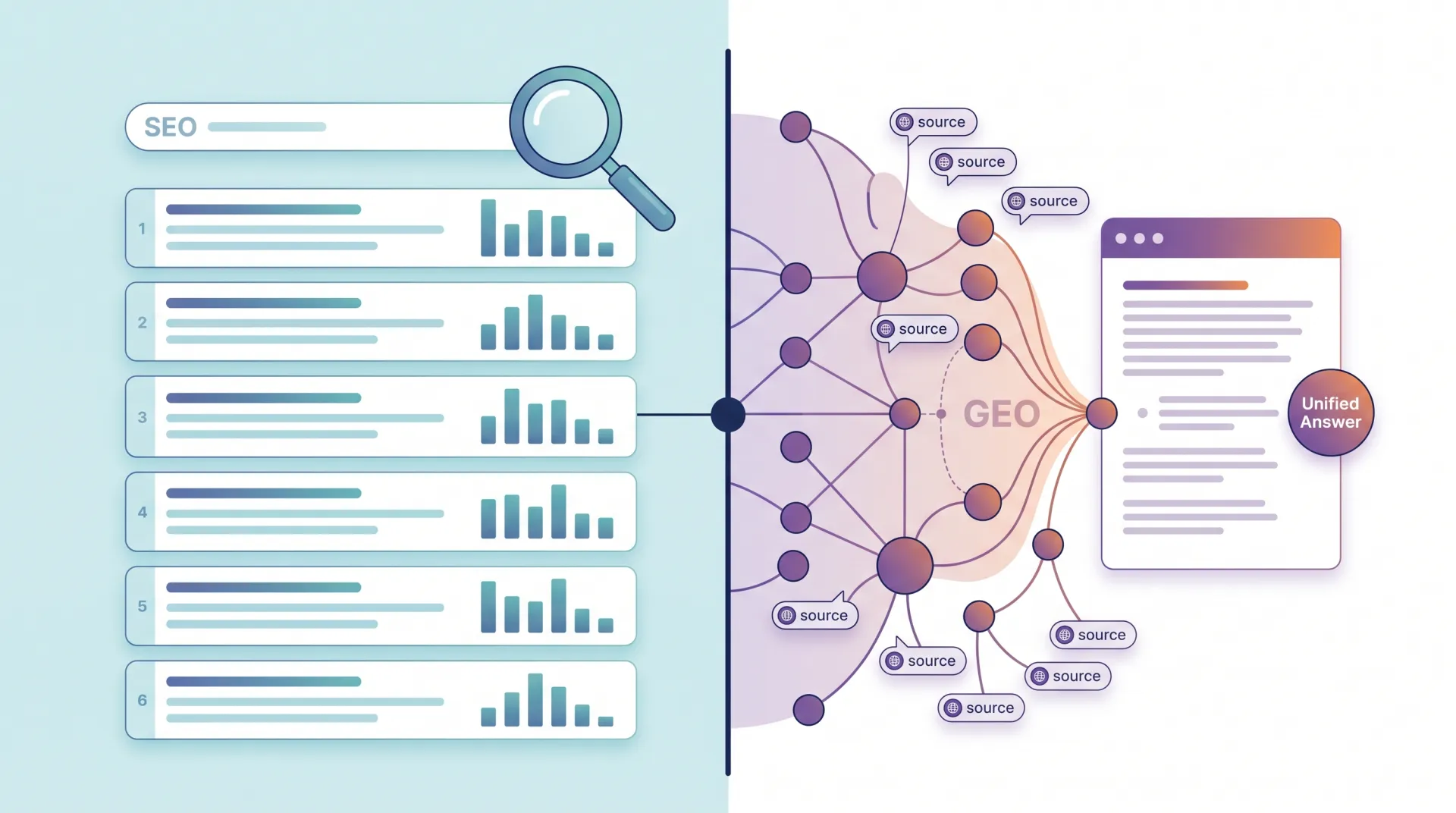
In practice, AI visibility rests on three pillars. Miss one, and you remain invisible – no matter how good your SEO is.
1. Technical accessibility: can AI actually read your site?
AI models use their own crawlers: GPTBot, PerplexityBot, ClaudeBot, Google-Extended. These bots must be explicitly granted access to your website.
Many sites block them – usually without realizing it. Sometimes the block is in the robots.txt, sometimes in the security layer. The result is the same: your site is invisible to AI, and you don't know it.
In addition, structured data (schema.org markup, clear metadata, a clean sitemap) counts as a signal that helps AI understand what is on your page.
2. Content that AI picks up quickly
AI models read differently than humans. They look for clear, self-contained answers.
A good test: take a random paragraph from your website. Does it stand on its own? Does a reader understand what you mean without the rest? If so, then AI can cite it too.
That means: thinking in questions instead of keywords, putting the answer at the top, and working with a clear structure – numbered lists, comparisons, FAQ sections. Not because it looks nice, but because AI draws from it more quickly.
This aligns perfectly with what Google has prioritized since its recent Core Update: human, expert, in-depth content. Anyone already doing that work has often completed 80% of their GEO efforts.
3. Authority outside your own website
The biggest mental shift: AI doesn't just judge you on what's on your site, but primarily on what is written about you elsewhere.
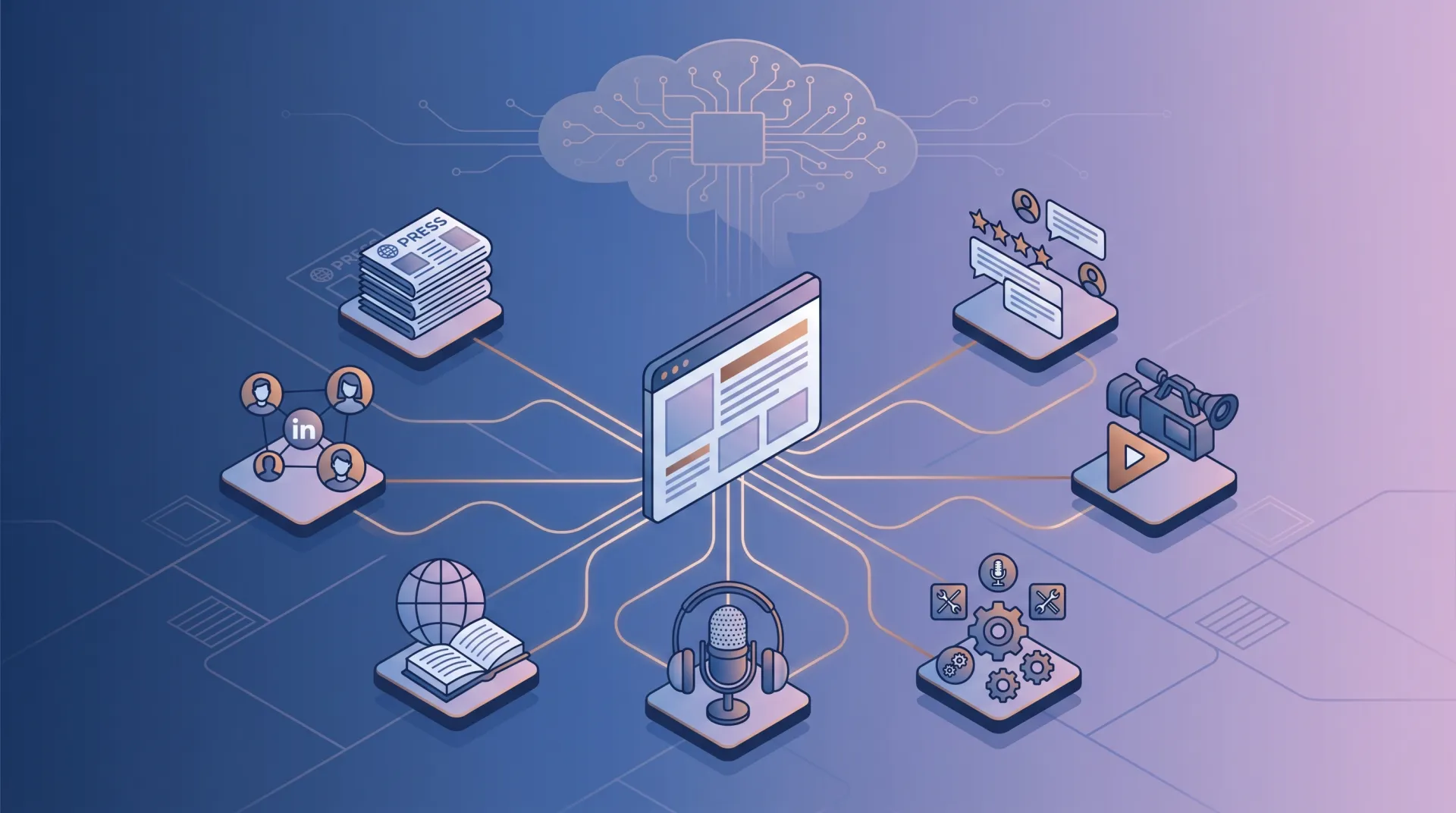
Are you mentioned on industry sites? Are you in Wikipedia or on knowledge platforms? Do you appear in the press, podcasts, or LinkedIn articles? Is your business information consistent across the entire web?
You no longer build authority solely on your own site. You build it throughout the entire ecosystem surrounding it.
1. Test what is currently being said about you. Ask ChatGPT, Claude, Perplexity, and Gemini which players are leading in your sector. Do you appear? Do your competitors appear? This is your baseline.
2. Check your technical AI accessibility. Can AI crawlers reach your site? Is your schema markup correct? Fundamental work that often yields results within a few weeks.
3. Restructure your most important pages around real customer questions. Don't write your content around keywords, but around the questions your customers actually ask. Use their phrasing. Think like your customer!
4. Strengthen your presence outside your own site. Press, trade media, LinkedIn, partner sites. Not for the volume, but for the consistency of your expertise signals.
5. Monitor your AI visibility just as you monitor your SEO rankings. If you measure it, you can manage it.
To be clear: SEO remains valuable. Google still processes billions of search queries every day. But a new layer has been added—one that is growing rapidly and rewarding different types of content.
The companies that will stand out in 2026 are those that take their digital strategy to the next level. It’s not just about having a digital presence ; it’s about being discoverable on every channel where your customers ask their first question – whether that’s Google, ChatGPT, Claude, Perplexity, or an AI assistant that hasn't even launched yet.
Discover where your company stands in AI Search today
Digital transformation should be based on insight, not gut feeling. And that applies just as much to AI Search visibility.
With a D'M&S AI Visibility scan , we map out how your organization currently performs within ChatGPT, Perplexity, and Google AI Overviews. We analyze your technical AI accessibility, the extractability of your content, and the signals your brand projects across the broader digital ecosystem.
You won't get a theoretical report, but practical insights into where your biggest gains in AI visibility lie – and where you are already being overtaken by competitors who got a head start.